Sleeve Notes: Britain's Record Shops Are Quietly Becoming Contemporary Art Rooms
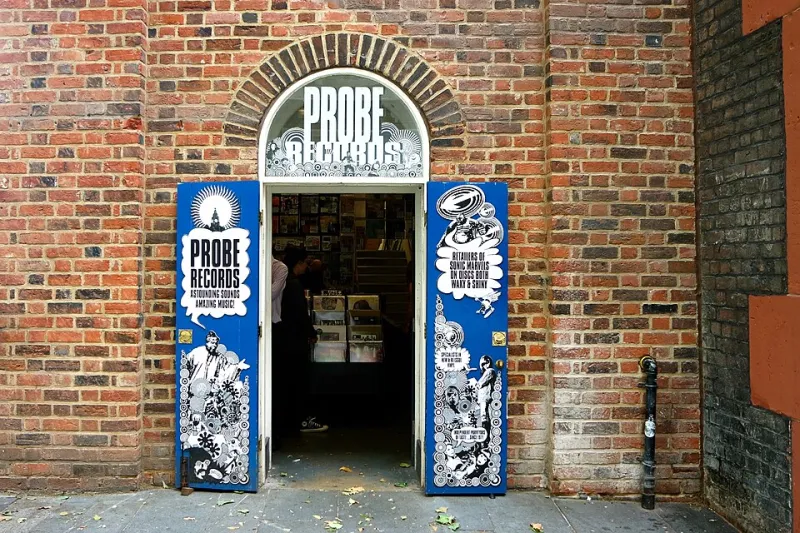
Photo: Matt Harrop , CC BY-SA 2.0, via Wikimedia Commons
A record shop is already an exercise in visual curation. The sleeve is a twelve-inch artwork hung at eye level in a rack, and the people who browse it have been trained, often without noticing, to judge a surface quickly and decisively. It is not entirely surprising, then, that a number of Britain's independent record retailers have begun hanging work on their own walls — or that the results have been more commercially interesting than the phrase 'art in a record shop' might suggest.
The Space Problem and the Space Solution
Most independent record shops in the UK occupy awkward premises: a long narrow shopfront, a stockroom, and a back room that once held overspill vinyl and now, thanks to streaming's effect on catalogue demand, holds rather less. Those rooms are heated, lit, insured and, crucially, already paid for. The marginal cost of hanging a show in one is close to nil.
Shops in Manchester, Glasgow, Bristol, Leeds and Brighton have taken up the opportunity at varying levels of formality — from a single wall behind the counter to a programmed back room with a private view and a printed list. The arrangements differ, but a common model has emerged: the shop takes no commission, or a nominal fifteen per cent to cover invigilation and card processing, and the artist supplies the hang and the labels.
Why the Crossover Audience Works
The demographic overlap is the strongest argument for the format. Vinyl buyers skew towards the design-conscious, the visually attentive and the habitually curious — a person who will spend £28 on a reissue because of the typography is a plausible candidate for a £200 screenprint. And, unlike a gallery visitor, they did not come in intending to look at art. That absence of intent is precisely the point.
Dwell time matters too. A record shop rewards browsing; customers stay twenty, thirty, forty minutes. A gallery on a high street might hope for ten. Every one of those additional minutes is time spent in the same field of vision as the work on the wall.
The Economics of a Modest Exhibition
For the artist, the arithmetic is attractive in the early career stage. A back-room show typically carries no hire fee, no framing requirement beyond good sense, and no obligation to produce a large body of new work. A run of eight to twelve pieces is sufficient. Nor is there the pressure of a formal solo presentation; the framing of the event as a shop's wall means that a modest sale is treated as a success rather than a shortfall.
For the shop, the returns are less about income than about atmosphere. A changing wall gives regular customers a reason to return and gives the shop a cultural identity beyond stock. Several retailers spoken to for this piece described the exhibitions as a marketing cost they no longer have to pay — a way of being a venue rather than merely a retailer.
What the Artists Say
Practitioners who have shown in these spaces tend to make the same observation: the conversations are better. Buyers ask about process rather than provenance, and they ask it directly. There is no intermediary to interpret, and no expectation that the artist will arrive wearing a particular kind of jacket.
The trade-off is visibility. A back room in a record shop does not attract a critic, a curator or a collector with a storage facility. It attracts people who are in the shop. That is a narrower audience, but a warmer one, and the conversion rate from conversation to sale is, anecdotally, high.
Practical Considerations for Both Sides
Any shop considering the format should attend to the mundane. Lighting in back rooms is frequently poor; a track of adjustable spots is an inexpensive upgrade and transforms the appearance of work. Insurance should be clarified in writing — most shop policies will not cover artworks on display. Hanging systems should avoid damaging original surfaces, and a simple inventory sheet signed by both parties will prevent the awkwardness that follows a missing print.
Artists should be realistic about hanging times, which frequently fall outside trading hours, and about invigilation, which in practice means the shop staff. Labels ought to include price, title and a contact route; QR codes to an artist's site now perform reliably, provided they are tested on the day.
A Route, Not a Destination
The temptation is to overstate this. Record-shop galleries will not replace the dealer system, and they should not be asked to. What they offer is a genuinely low-friction first exhibition — a place to test a hang, meet buyers and sell without the overheads that make early-career shows so punishing. In a market where the cost of a first solo can run to four figures before a single work is sold, that is not a small thing. It is, quietly, a distribution network.