Second-Hand, First Rate: The Case for Looking for Contemporary Art in Charity Shops
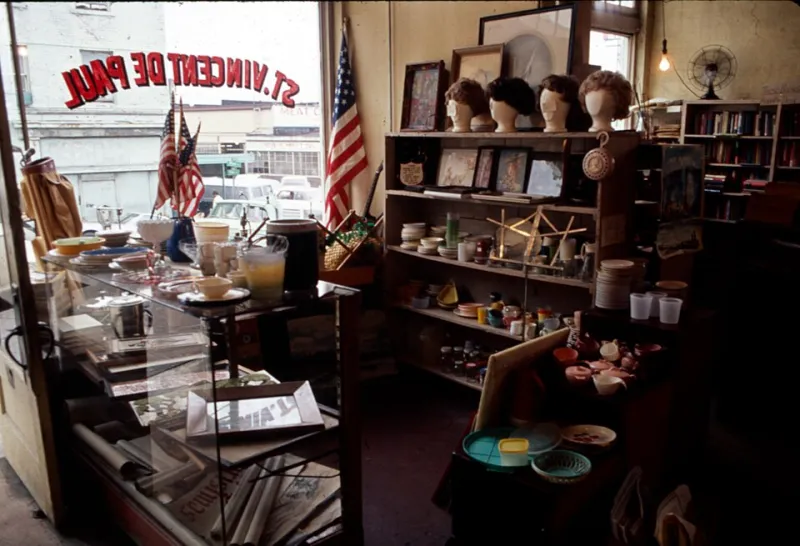
Photo: Seattle Municipal Archives from Seattle, WA, CC BY 2.0, via Wikimedia Commons
The British charity shop has always sold pictures. What has altered is the kind of picture. Alongside the framed jigsaw and the reproduction of a Venetian canal, shelves in larger branches now regularly hold original works: a signed etching, a small oil on board, a screenprint from an edition of forty. The supply is not a curiosity. It is a consequence of how property now moves through British life.
How Contemporary Work Ends Up on the Rail
Three routes dominate. The first is the estate clearance, where a house is emptied at speed and the contents are distributed by a solicitor's instruction rather than by anyone with an interest in art. The second is the house move, particularly the downsize, where storage is scarce and a decision is made in an afternoon. The third, less common but growing, is the artist's own clear-out: unsold stock from a career, donated to a cause rather than stored for another decade.
In each case, the person making the donation is not usually attempting to sell. That is what makes the pricing so erratic. A volunteer in a shop in Shropshire may price a work at £15 because it is unframed, while an identical piece in a London branch may carry £150 because somebody recognised the signature.
The Ethical Question Nobody Asks
Here the argument becomes less comfortable. A charity shop sale benefits a charity, but it does not benefit the artist, and contemporary work sold at a fraction of its studio price can affect how that artist's market is read. Dealers are understandably wary of a situation in which a buyer cites a £20 charity-shop find as evidence of an artist's value.
The counter-argument is that donated work was, in most cases, already outside the commercial system — a gift, a remainder, an inheritance nobody wanted. An artist is not deprived of income by a sale that would otherwise not have happened at all. And there is a practical consideration: refused donations go to landfill or to bulk rag merchants, which serves nobody.
A middle path is emerging in a number of larger charities, which now route signed or evidently professional work to specialist online listings rather than to the shop floor. This produces a better return for the cause without turning the high street into a discount gallery, and it is, on balance, the direction the sector should take.
A Note on Resale Right
The Artist's Resale Right gives living artists — and the estates of those who have died within the last seventy years — a royalty on certain resales. The rules are technical, and whether a particular charity shop transaction falls within them depends on the nature of the sale and the parties involved. Collectors buying anything of substance should assume the possibility and, where a work is clearly by a known hand, take advice rather than assume. Organisations such as DACS publish plain-English guidance, and their material is worth ten minutes of anyone's time.
Advice for the Willing Searcher
Go often, and go early. Stock turns quickly, and the strongest branches for pictures are usually those near affluent suburbs and in towns with an active artistic population. Look at the back of the frame: exhibition labels, gallery stickers and handwritten inscriptions are the most reliable indicators of a serious work. Examine the signature with a loupe — a printed reproduction of a signature is usually visible as a dot pattern under magnification.
Ask staff whether there are unframed works in the back. Ask about provenance, politely, and accept that the answer may be that there is none. Do not haggle; the price is already a donation, and the negotiation reads badly.
Finally, consider what you do next. A buyer who finds a genuine work at a low price and later writes to the artist — or, better, buys a second piece from them directly — is participating in the market rather than extracting from it. That distinction is not merely sentimental. It is the difference between a market that functions and one that quietly cannibalises its own producers.
What It Means for the Wider Trade
The charity shop is not a rival to the gallery, and framing it as one misreads the situation. It is a salvage operation at the edge of the market, catching work that would otherwise be lost. But it is also a genuine entry point: a place where somebody who has never bought original art can spend £40 and discover that they would like to spend £400.
The sensible position for the trade is neither to ignore this nor to deplore it, but to recognise that every donated canvas once had a buyer, and that the health of the secondary market depends on the health of the primary one. Look closely, buy well, and pay the artist when the opportunity arises. It is not a complicated ethic, but it is worth stating.