The School Sale That Started a Collection: How Secondary Schools Are Bringing Original Art to Families Who Never Knew They Were Buyers
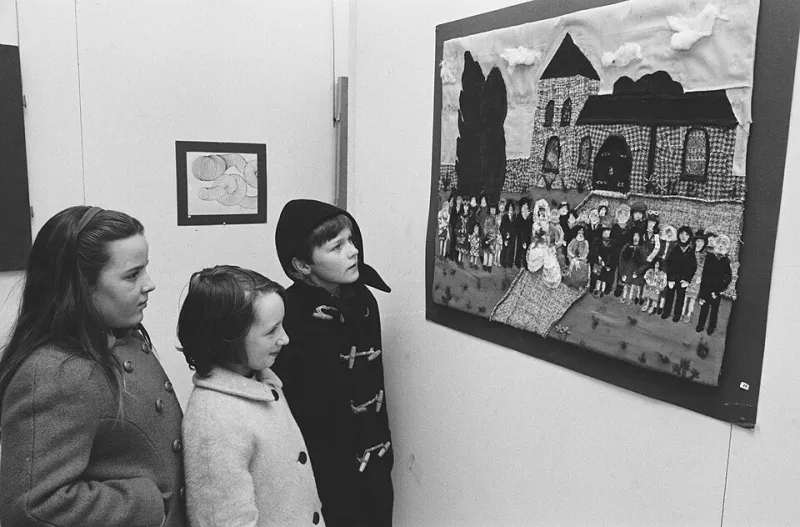
Photo: Geoff Charles, CC BY-SA 4.0, via Wikimedia Commons
An Unlikely Venue, An Unexpected Transaction
The sports hall at a comprehensive school in Coventry is not an obvious site for an art market revelation. Yet on a Thursday evening in November, beneath fluorescent lighting and surrounded by folding tables draped in white cloth, a secondary school teacher named David Okafor watched a parent spend forty-five minutes in front of a painting before quietly asking whether it was for sale.
 Photo: David Okafor, via irp.cdn-website.com
The painting was by a Year Eleven student. It cost thirty-five pounds. The parent — a nurse who had never previously bought original art — took it home that evening. Six months later, she returned to the school's second annual sale and purchased a limited-edition print by a Midlands-based artist the school had invited to exhibit alongside its students. The price was £180. She did not hesitate.
'That is the moment we are trying to create,' says Okafor, who established his school's annual art sale four years ago and has since seen it grow from a modest fundraising exercise into a fully curated event attracting over two hundred visitors. 'Not the big sale, not the expensive piece — the first one. Everything follows from there.'
A Movement With Momentum
Across Britain, a growing number of secondary schools and sixth-form colleges are running events that go considerably beyond the traditional end-of-year display. These are structured sales, carefully curated, with professional pricing frameworks, artist statements, and — in the more developed programmes — invited contemporary artists exhibiting and selling alongside students.
The movement does not have a central organising body or formal name. It has grown organically, driven by art teachers who have recognised a commercial and cultural opportunity that the established gallery system has largely failed to exploit: the family unit as a natural collecting entity, already present in the school community, already emotionally invested in creative work, and lacking only the occasion and permission to buy.
Some of the most developed programmes are operating in areas where commercial galleries are scarce or absent. In rural Lincolnshire, a sixth-form college has run an annual sale for six consecutive years, attracting buyers from a catchment area that encompasses several market towns with no dedicated art retail presence. In South Wales, a comprehensive school's spring sale has become sufficiently established to attract media coverage and waiting lists for exhibiting artist places.
The Invited Artist Model
The inclusion of invited contemporary artists alongside student work is the element that most distinguishes these events from conventional school exhibitions. It serves several functions simultaneously.
For the school, it signals seriousness of purpose and raises the cultural credibility of the event. For the invited artist, it provides access to a warm, engaged audience with disposable income and genuine emotional investment in the occasion. And for the families attending, it creates a natural bridge: the student work they have come to see is exhibited in the same space, on the same terms, as the work of a professional — normalising the idea that original art is something ordinary people buy.
Painter and printmaker Clare Sutton, based in Sheffield, has participated in three school art sales over the past two years and regards them as among her most commercially productive events of the calendar. 'The families come to see their children's work, and they are already in a generous, celebratory mood. When they encounter my work alongside the students', they are curious rather than intimidated. They ask questions they would never ask in a gallery — about process, about how long something took, about whether I do commissions. Those conversations lead to sales.'
 Photo: Clare Sutton, via ilarge.lisimg.com
Sutton reports that her average sale price at school events is lower than at art fairs, but her conversion rate — the proportion of conversations that result in a purchase — is markedly higher. 'These are not browsers. They are people who have already decided, emotionally, that this is a good place to spend money. I am simply the beneficiary of that decision.'
What Parents Say
For the families making their first-ever original art purchase at these events, the experience is frequently described in terms of surprise — not at the quality of the work, but at the ease of the transaction.
Mark and Joanne Prescott, from Guildford, attended their daughter's school art sale last spring with no intention of buying. Their daughter, then in Year Ten, had two pieces in the exhibition. They left with one of her paintings and a small ceramic bowl by an invited artist from Surrey, for a combined expenditure of under £120.
'We had always thought of buying art as something complicated,' Joanne explains. 'You needed to know about artists, know about value, know what you were doing. At the school sale, none of that applied. The price was on the label, the artist's name was on the wall, and the work was right in front of you. There was nothing to work out. We just bought what we liked.'
Mark adds: 'We went back the following year and bought something more expensive — a print by the same artist we'd found at the first sale. We'd looked her up in the meantime. We felt like we were following someone's career.' He pauses. 'I suppose that makes us collectors, doesn't it?'
The Curriculum Connection
The most thoughtfully designed school sale programmes are not operating in isolation from the curriculum. In several schools, the commercial event is integrated into a broader programme of arts education that includes visits to regional galleries, workshops with practising artists, and structured discussion of how the contemporary art market functions.
This contextualisation matters. Students who understand the economic reality of an artist's working life — who grasp that sales are not peripheral to artistic practice but foundational to it — are better prepared to participate in the market as adults. Their parents, drawn into this conversation through the sale itself, receive an informal education in collecting that no commercial gallery has managed to deliver at comparable scale.
Art teacher Fiona Baxter, who runs a celebrated programme at a school in North Yorkshire, is explicit about this ambition. 'I want my students to leave school understanding that art is made by real people who need to earn a living, and that buying art is a way of participating in culture rather than observing it. If I can also give their parents that understanding, I have done something that will outlast anything I teach about technique or art history.'
A Decade From Now
The families currently making their first purchases at school art sales in Coventry, Sheffield, and rural Lincolnshire will, within a decade, represent a meaningful constituency of experienced collectors. They will have purchased, discussed, and lived with original work. They will have followed artists' careers, attended further events, and introduced the habit of buying to their social networks.
This is not a trivial prospect. Britain's contemporary art market has long been characterised by a relatively narrow collector base — concentrated geographically, socially, and culturally. The school sale movement, modest and informal as it remains, is working against that concentration from the ground up, one sports hall, one folding table, and one first purchase at a time.
For the artists who participate, the galleries that might one day represent their buyers, and the broader ecosystem of British contemporary art, that is a development worth watching with considerable attention.