Heritage Walls, Living Artists: How National Trust Properties Are Reshaping British Art Careers
Photo: Baltimore Heritage, CC BY 2.0, via Wikimedia Commons
For most of its history, the National Trust has been regarded as the guardian of what was — a custodian of ancestral portraits, Georgian silverware, and rooms preserved precisely as their long-departed occupants left them. Yet something is shifting beneath those carefully maintained rooflines. Across England, Wales, and Northern Ireland, Trust properties are opening their doors — and their walls — to living, working British artists, and the consequences for those artists' careers are nothing short of remarkable.
 Photo: National Trust, via roundandabout.co.uk
With over 28 million visits recorded across its portfolio of properties each year, the National Trust represents one of the most substantial concentrations of engaged, culturally curious audiences in the country. For a contemporary artist accustomed to the modest footfall of a regional gallery, the exposure offered by even a modest Trust placement can be career-altering.
A Curatorial Shift Decades in the Making
The Trust's interest in contemporary art is not entirely new. Isolated commissions and artist residencies have appeared sporadically across its estate since the 1990s. What has changed in recent years, however, is the deliberateness of the approach. Properties are increasingly developing structured commissioning programmes, working with curators who specialise in bridging the historic and the contemporary rather than treating the two as incompatible.
At Kedleston Hall in Derbyshire, for instance, recent seasons have seen textile works by living British makers installed in dialogue with the house's neoclassical interiors — a curatorial decision that drew considerable attention from collectors visiting the property. Similarly, Tyntesfield in Somerset has hosted a series of artist responses to its Victorian Gothic architecture, with several participating artists reporting direct approaches from buyers who encountered their work during a family day out.
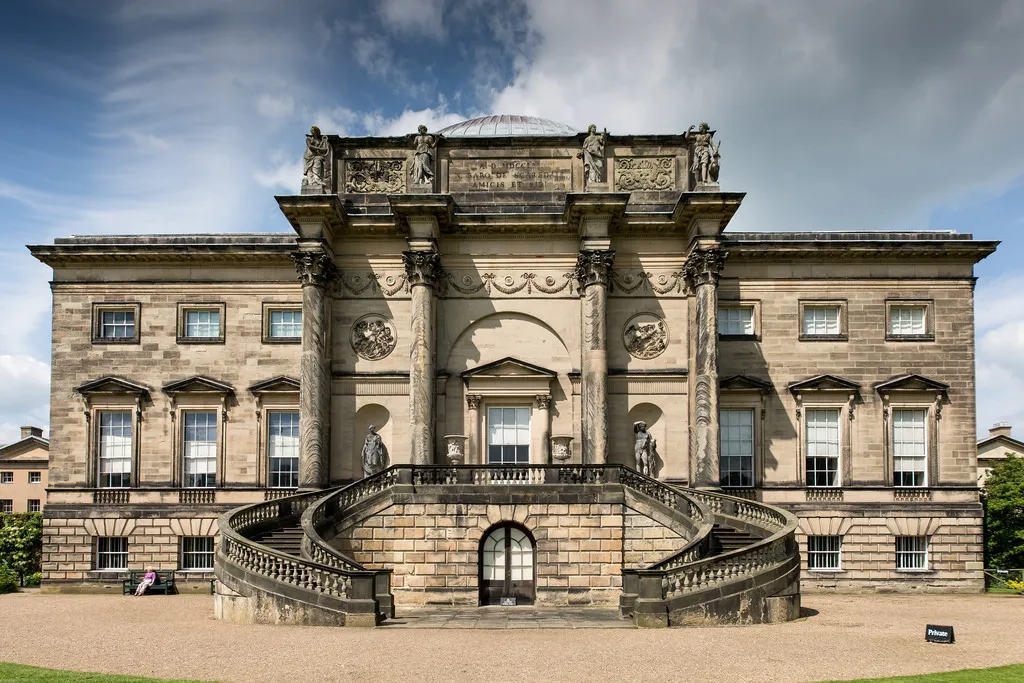 Photo: Kedleston Hall, via megaconstrucciones.net
The curatorial logic, as articulated by Trust staff working on these programmes, is one of conversation rather than contrast. The aim is not to shock visitors with jarring juxtapositions, but to invite them to see the historic environment afresh through a contemporary lens. When that conversation lands well, the results resonate far beyond the property's grounds.
The Commercial Arithmetic of Historic Footfall
For artists, the mathematics of National Trust exposure are compelling. A mid-sized Trust property — a manor house in the Cotswolds, say, or a coastal castle in Cornwall — might receive 200,000 visitors in a single season. Even if only a fraction of those visitors engage meaningfully with a contemporary commission, the cumulative effect on an artist's visibility is considerable.
Several artists who have participated in Trust programmes describe a pattern that will be familiar to anyone who has studied how art careers develop: the placement itself generates press coverage; the press coverage attracts gallery interest; the gallery interest leads to representation; and representation, in turn, opens the door to the kind of sustained commercial success that a single exhibition rarely achieves alone.
One ceramicist, whose work was displayed at a Trust property in the Lake District, described receiving more enquiries in the three months following her placement than in the preceding three years of exhibiting through conventional gallery channels. She attributed this partly to the Trust's own communications — newsletters, social media, and the property guidebook all featured her work — and partly to the simple fact that Trust visitors tend to be property owners with both the wall space and the disposable income to invest in original art.
Scouting the Stately Homes
Dealers and collectors have begun to take note. A number of art advisers working with private clients now include Trust programme announcements in their research calendars, treating participation in a major property commission as a credible signal of curatorial endorsement.
This is not without precedent. The relationship between institutional endorsement and commercial value is well established in the art world, but what makes the Trust context distinctive is the breadth of the audience it commands. Unlike a prestigious gallery show, which may attract a relatively narrow demographic of existing art market participants, a Trust placement reaches retired couples, young families, school groups, and international tourists — all potential first-time buyers, many of whom encounter the artist's work in a context that feels approachable rather than intimidating.
For collectors already active in the contemporary British market, Trust commissions offer a different kind of signal: evidence that an artist's work can hold its own in demanding architectural environments, and that it has been subjected to a rigorous, publicly accountable selection process.
Practical Pathways for Emerging Artists
For artists seeking to engage with this ecosystem, the routes in are more accessible than many assume. The National Trust does not operate a single centralised commissioning process; individual properties and regional teams frequently issue open calls for residencies, temporary installations, and site-specific commissions. The Trust's own website lists opportunities, and regional arts officers — often working in partnership with Arts Council England or Creative Wales — can provide guidance on forthcoming programmes.
Artists who have successfully navigated these pathways consistently emphasise the importance of proposal quality over portfolio prestige. Trust curators are, by the nature of their role, deeply attentive to context. A proposal that demonstrates genuine engagement with a specific property's history, landscape, or architectural character will invariably outperform a generic application, however technically accomplished.
Building relationships with Trust volunteers and staff — attending open days, engaging with public events — can also provide invaluable insight into a property's curatorial priorities before a formal application is submitted.
A Platform Unlike Any Other
Britain's historic environment has always been a mirror of its cultural ambitions. That the National Trust is now actively choosing to reflect contemporary British creativity within that mirror is both symbolically significant and practically consequential for the artists involved. For those whose work finds a home on a Trust wall, the audience waiting on the other side of the entrance gate is unlike anything the conventional gallery circuit can offer — and the commercial opportunities that follow are only beginning to be fully understood.