The Listening Collector: How British Artists Are Using Podcasts to Build Audiences That Buy
There is an irony at the heart of the contemporary art world's relationship with digital media. An industry built entirely on visual experience has spent the past decade trying to sell itself through images — on Instagram, on Pinterest, on increasingly sophisticated gallery websites — with results that are, at best, mixed. The photograph of a painting is not the painting. The gallery view on a screen is not the gallery. Something essential is always lost in translation.
Podcasting, by contrast, makes no attempt at visual representation. It offers something entirely different: the unmediated voice of the artist, speaking at length, in their own words, about the work, the process, the doubt, the ambition. And it turns out that this is precisely what a significant number of prospective collectors have been waiting to hear.
Why Audio Works Where Images Fall Short
The appeal of the podcast format for artists is not immediately obvious. Visual work, one might reasonably assume, demands visual presentation. Yet practitioners and collectors who have engaged seriously with art podcasting describe a quality of connection that the visual channel struggles to replicate.
"When you look at an image of a painting online, you are evaluating it," observes one ceramicist based in Edinburgh whose podcast, launched during the pandemic, now attracts several thousand regular listeners. "When you listen to an artist talk for forty-five minutes about why they make what they make, you are not evaluating. You are understanding. That is a completely different relationship."
This distinction — between evaluation and understanding — maps directly onto the psychology of collecting. Research into collector behaviour consistently finds that emotional and intellectual connection to an artist's practice is among the most powerful drivers of purchase decisions, particularly for buyers who are not primarily motivated by investment considerations. The podcast, by providing sustained, intimate access to an artist's thinking, is extraordinarily effective at building precisely that kind of connection.
The Format's Particular Intimacy
Podcasts are, by their nature, consumed in private, often during activities that occupy the body but free the mind: commuting, exercising, cooking, walking. This context creates a quality of attention that is quite different from the scrolling, fragmentary engagement typical of social media. Listeners who choose to spend an hour with an artist's conversation are self-selecting for genuine interest. They are not passive recipients of an algorithm's suggestion but active participants in a chosen experience.
For British artists who have built podcast audiences, the quality of that engagement is consistently noted as superior to other digital channels. Comments and correspondence from listeners tend to be more substantive, more personal, and more indicative of genuine interest in the work than responses to visual content.
"Someone who has listened to me talk about my relationship with the Yorkshire landscape for an hour knows something about me that a hundred Instagram posts could never convey," explains one landscape painter based in Harrogate who has appeared as a guest on several well-regarded art podcasts. "When they come to look at the work after that, they are not starting from zero. They have a context. They care."
Bypassing the Gatekeepers
For emerging artists in particular, the podcast represents a meaningful alternative to the traditional gallery system as a route to audience development. The conventional path — art school, group shows, representation, solo exhibition — is slow, competitive, and heavily concentrated in London. Podcasting operates entirely outside these structures.
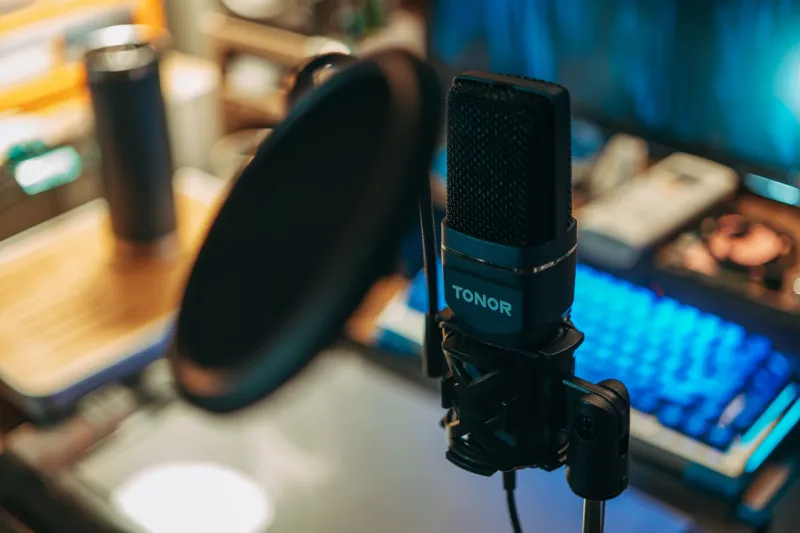
An artist in Norwich or Inverness or Newport can reach a national audience of engaged listeners without a gallery affiliation, a London postcode, or a press contact. The barriers to entry are low: a decent microphone, a quiet room, and the willingness to speak honestly about one's practice. The potential reach is, in principle, unlimited.
Gallery Top has observed this dynamic playing out with increasing frequency among the artists it features. Several have noted that a significant proportion of their most recent sales — including commissions at prices that would once have required gallery mediation — originated with listeners who encountered them through audio content before ever seeing the work.
The Collector Who Listens First
The demographic emerging from podcast-driven art discovery is worth examining. These are, broadly, people who are already habitual podcast consumers — typically educated, professionally engaged, and accustomed to long-form content. They are not necessarily existing art buyers. Many describe themselves as having been vaguely interested in art without knowing how to begin collecting, and as having found in an artist's podcast a permission structure that gallery environments had never provided.
"I had always felt slightly intimidated by galleries," admits one listener in her late thirties, a marketing professional from Bristol who has purchased three works over the past two years from artists she encountered through podcasts. "The podcast made the artist feel like someone I knew, or at least someone whose thinking I understood. Walking into a gallery to buy their work felt completely natural after that. There was no anxiety."
This dissolution of anxiety — the lowering of the psychological threshold that deters many potential buyers from making their first original art purchase — is one of the podcast format's most commercially significant effects.
Building the Practice in Public
The most effective artist podcasters tend to share a particular quality: a willingness to discuss not only finished work but the messy, uncertain, often frustrating process of making it. Failure, revision, doubt, and creative dead ends are addressed with the same candour as success. This transparency is, paradoxically, one of the most powerful commercial assets an artist can deploy.
Collectors who have followed an artist's creative journey through audio — who have heard the doubts, the breakthroughs, the rejection and the recalibration — develop a relationship with the work that goes far beyond aesthetic appreciation. They have, in a meaningful sense, been present for its creation. The purchase of a finished piece becomes, for such collectors, a form of participation rather than mere acquisition.
An Audio Future for British Art
The podcast is not, of course, a replacement for the gallery, the art fair, or the studio visit. It is an addition to the ecosystem — a channel that reaches people who might never otherwise find their way to an original work, and that builds the kind of sustained, informed engagement on which lasting collecting relationships depend.
For contemporary British artists willing to invest in the format, the returns extend well beyond immediate sales. An audience of engaged listeners is an audience that follows a career, advocates to friends, and returns, repeatedly, to buy. In a market where collector retention is as valuable as collector acquisition, that kind of loyalty is worth more than any number of viral images.
The gallery of the future may well begin, for many collectors, not with a painting on a wall, but with a voice in their ear.