In the Artist's Own Hand: The Personal Letter That Is Changing How Britain Collects Art
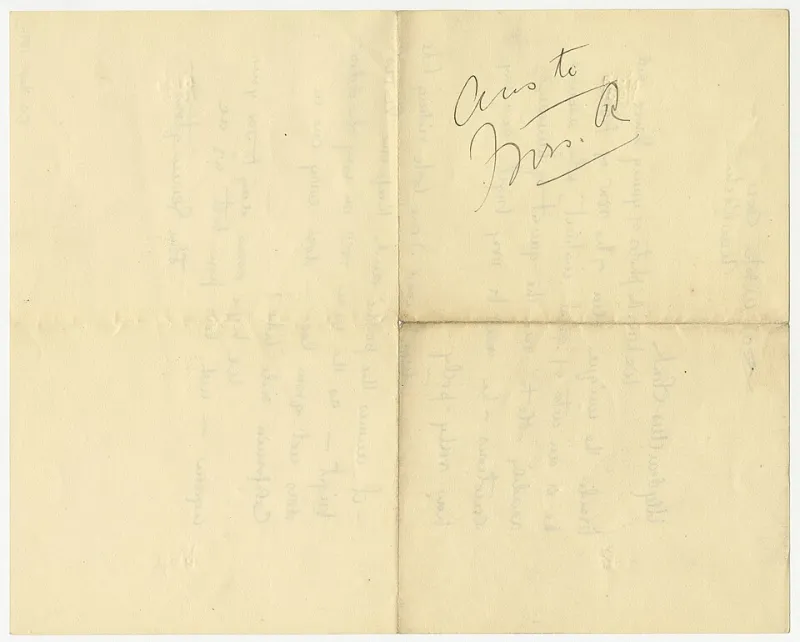
Photo: Remington, Eva A, Public domain, via Wikimedia Commons
In the Artist's Own Hand: The Personal Letter That Is Changing How Britain Collects Art
The parcel arrives like any other. Brown paper, careful packaging, the particular weight of a canvas or a framed print. But inside, alongside the work itself, there is something unexpected: a folded sheet of paper, covered in handwriting. Not a printed certificate, not a typed invoice, but a genuine letter — addressed to the collector by name, written by the artist whose work they have just acquired.
For a growing number of British art buyers, this moment has become one of the most memorable aspects of collecting. And for the artists who have made personal correspondence a deliberate part of their practice, the returns — both commercial and relational — have been considerable.
A Gesture Against the Algorithm
To understand why the handwritten letter has acquired such resonance in contemporary British art, it helps to consider the environment in which most art is now discovered and purchased. Social media platforms surface work through engagement metrics. Online marketplaces present pieces as products, complete with dimensions, shipping costs, and return policies. The transaction is efficient, often seamless, and almost entirely impersonal.
Against this backdrop, the handwritten letter functions as a deliberate act of resistance. It signals that the artist has paused, taken paper and pen, and addressed themselves directly to the person who will live with their work. It is a small act, but its symbolic weight is disproportionate to its scale.
"I started writing to buyers about three years ago," explains Glasgow-based painter and printmaker Callum Fraser, whose work has found collectors across Britain and in several European countries. "Initially it felt almost embarrassingly simple — just a note saying thank you, explaining what I was thinking about when I made the piece. But the response was extraordinary. People wrote back. Some of them became my most committed collectors. One woman has bought seven pieces now, and she has told me she keeps every letter."
 Photo: Callum Fraser, via smartcdn.gprod.postmedia.digital
The Psychology of Provenance
The appeal of personal correspondence from an artist is not simply sentimental. It intersects with something fundamental to the psychology of collecting: the desire for authenticity, for a traceable connection between object and maker.
Provenance — the documented history of an artwork's ownership and origins — has long been understood as a significant component of value in the fine art market. For works by established historical figures, provenance can represent the difference between a minor and a major sale. For contemporary artists, the equivalent mechanism operates differently but with comparable force. A handwritten letter constitutes a form of primary provenance: direct testimony from the artist about the work's creation, in their own hand, at the moment of its first sale.
"There is something irreplaceable about the first owner relationship," observes art consultant and collector Patricia Ngozi, who has been acquiring British contemporary work for over fifteen years. "When an artist writes to you directly — when they tell you what the painting meant to them, what they were trying to resolve — you become part of the work's story. That is not a small thing. It changes how you look at the piece. It changes how you feel about parting with it."
The reluctance to sell, it turns out, is commercially significant. Collectors who feel a personal connection to an artist tend to hold work longer, to acquire subsequent pieces, and to speak about the artist to others. The letter, in this sense, is not merely a courtesy — it is the foundation of a commercial relationship.
What the Letter Contains
The form varies considerably between artists, and the variation is itself revealing. Some write briefly: a paragraph of genuine thanks, a sentence or two about the work's genesis, a closing wish for the collector's enjoyment of the piece. Others produce substantial correspondence — two or three pages of reflection on the ideas that animated a particular series, the specific conditions under which a painting was made, the difficulties overcome and the discoveries encountered.
Northumberland-based landscape artist Helena Marsh has developed what she describes as a "letter of origin" that accompanies every original sale. "It is not a certificate," she is careful to clarify. "Certificates are formal documents. My letters are personal. I write about the day I was in the field — the weather, the quality of the light, what I was trying to see. I tell the collector something they could not know from looking at the painting alone."
Marsh reports that her letters have become sufficiently well regarded among her collectors that several have specifically mentioned them in enquiries about new work. "I had someone contact me who had seen one of my paintings at a friend's home. They asked about the letter before they asked about the price. That told me something important."
The Certificate Reimagined
The handwritten approach is also influencing how artists think about the more formal documentation that accompanies original work. Certificates of authenticity — once the preserve of established galleries and auction houses — are increasingly being produced by independent British artists as a matter of course. The most thoughtful practitioners are treating these documents not as bureaucratic necessities but as aesthetic objects in their own right.
Hand-lettered certificates, signed and dated in ink, accompanied by a small original sketch or a pressed botanical element related to the work's subject, are among the approaches being adopted by artists who have understood that the documentation surrounding a piece contributes to its overall value proposition. The collector is not merely acquiring a painting; they are acquiring an artefact.
This attention to the complete package — artwork, letter, certificate, and in some cases a small additional original — is proving particularly effective at the middle market of the British contemporary scene, where buyers are making meaningful financial commitments and expect to feel that their purchase has been taken seriously.
Authenticity in the Digital Age
There is a broader cultural context worth noting. Britain's appetite for the handmade, the personal, and the demonstrably human has been growing in inverse proportion to the digitisation of daily life. The artisan food market, the resurgence of vinyl, the sustained popularity of independent bookshops — these are all expressions of the same underlying desire: for objects and experiences that carry the trace of a human being.
Art, of course, has always offered this. The brushstroke, the chisel mark, the artist's thumbprint in the clay — these are the irreducible evidence of human presence that no digital reproduction can provide. The handwritten letter simply makes that presence explicit, extending it beyond the work itself into an act of direct communication.
For Britain's contemporary artists, the lesson is clear: in a marketplace saturated with imagery and increasingly mediated by technology, the most powerful competitive advantage may be the simplest one. Pick up a pen. Write the letter. The collector on the other end is waiting to feel that connection — and when they do, they are unlikely to forget it.